Quick Design #3 (Part 2)
I’m still recovering from waiting outside of my local Lowes for 6 hours to get their Black Friday Bucket last night/this morning. I don’t think I’ll ever be warm again, but I had an idea that may or may not be good.
In my previous post I explored the idea of converting Anne’s 8 Abilities post into a resolution system inspired by Pendragon’s Traits.
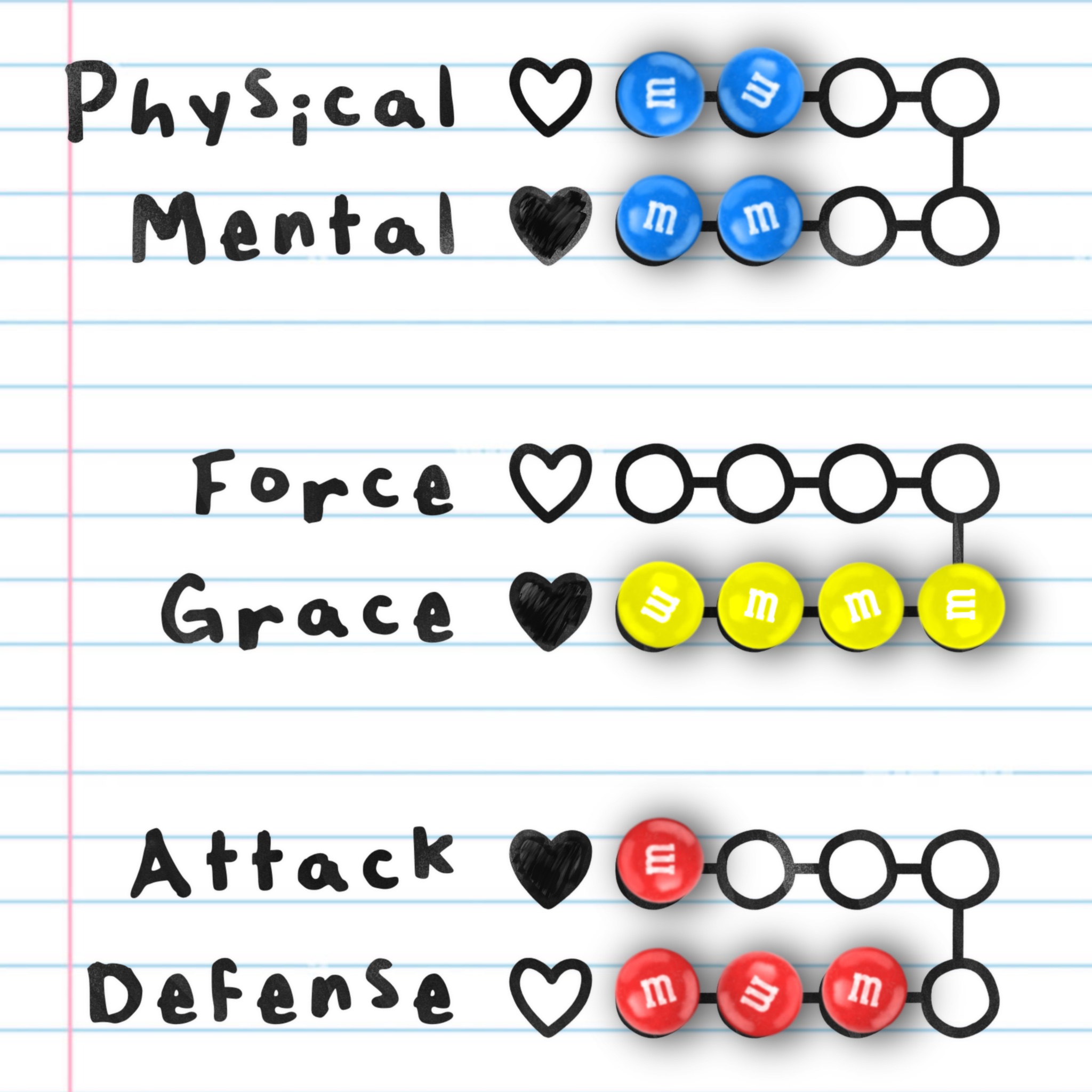
Jokingly, I named this system “Pencildragon” but I will likely change the name if I ever do anything with it outside of my blog.
The TL;DR is that your character has 6 traits paired into three dichotomies. Each pair has a combined 8 slots that share four “difficulty points” that shift based on successes and failures.
When you make an action, you translate the narrative using one trait from each dichotomy, adding the difficulty to get a target number.
🟦+🟨+🟥 = TN
This “TN” can be anywhere from 0-12 (technically 0-15 if you include the trauma mechanic from my original post) so you would roll a D12 in hopes of meeting or exceeding the TN.
An example I used in the original post was kicking down a door…
PHYSICAL 🔵🔵🔵⚪️ MENTAL 🔵⚪️⚪️⚪️ FORCE 🟡⚪️⚪️⚪️ GRACE 🟡🟡🟡⚪️ ATTACK 🔴🔴🔴⚪️ DEFENSE 🔴⚪️⚪️⚪️ "…in frustration, you attempt to break the door down with a kick…"
Physical Force Attack TN 🔵🔵🔵 + 🟡 + 🔴🔴🔴 = 7
…the concept is similar to a roll under ability score system, but I flipped it and made the ability score a personal difficulty that you are rolling over. There is no outside influence to the target number…
But what if there was an external difficulty score?
In the original post I mentioned I’d like to implement some sort of HP system that acts like a progress bar similar to ICRPG. This wouldn’t be applied to every single action, only for actions where time is a factor. If time isn’t a factor action rolls should be a simple yes/no.
🟩 What if objects/creatures had an HP range of 1-5 that doubles as difficulty points?
If a Wooden Door has 💚💚 that would mean it takes two successes to break down:
| Physical | Force | Attack | Door | TN | ||||
| 🔵 🔵 🔵 ⚪️ | + | 🟡 ⚪️ ⚪️ ⚪️ | + | 🔴 🔴 🔴 ⚪️ | + | 💚💚 | = | 9 |
Instead of using a D12, this new formula of “🟦+🟨+🟥+🟩” would use a D20 because it could range from 1-17 (or if the trauma mechanic from my original post is implemented 1-20). And just as using a tool would turn a D12 into 2D6, using a tool with this formula would turn a D20 into 2D10.
If you succeed you would shift difficulty points away from each stat and reduce the HP of the door. Attempting the same action a second a second time after a success would look like:
| Physical | Force | Attack | Door | TN | ||||
| 🔵 🔵 ⚪️ ⚪️ | + | ⚪️ ⚪️ ⚪️ ⚪️ | + | 🔴 🔴 ⚪️ ⚪️ | + | 💚 | = | 5 |
But if instead you failed the first attempt, you would shift the difficulty points towards each stat and the door’s HP would remain the same. Attempting the same action a second a second time after a fail would look like:
| Physical | Force | Attack | Door | TN | ||||
| 🔵 🔵 🔵 🔵 | + | 🟡 🟡 ⚪️ ⚪️ | + | 🔴 🔴 🔴 🔴 | + | 💚 💚 | = | 12 |
The whole philosophy behind this resolution system is encouragement. If you succeed with one type of approach, this system will reward you by making it easier to continue taking that approach. If you fail with one type of approach, this system will make a completely different approach easier.
Using the same example from my original post, after kicking the door fails you hear someone cowering on the other side of the door. Because your “physical” trait has all four difficulty points, your “mental” trait will now have zero difficulty points. You could demand that the person on the other side of the door unlock it for you, and that would bypass the door’s HP:
| Mental | Force | Attack | TN | |||
| ⚪️ ⚪️ ⚪️ ⚪️ | + | 🟡 🟡 ⚪️ ⚪️ | + | 🔴 🔴 🔴 🔴 | = | 6 |
Rolling a D12 against a TN of 6, is better odds than rolling a D20 against a TN of 12.
Haven’t put too much more thought into it yet. It will likely mess with the dice scaling I have with the magic system and the “safe actions” from the original post, but that’s all the braincells I have right now